06/02/2026
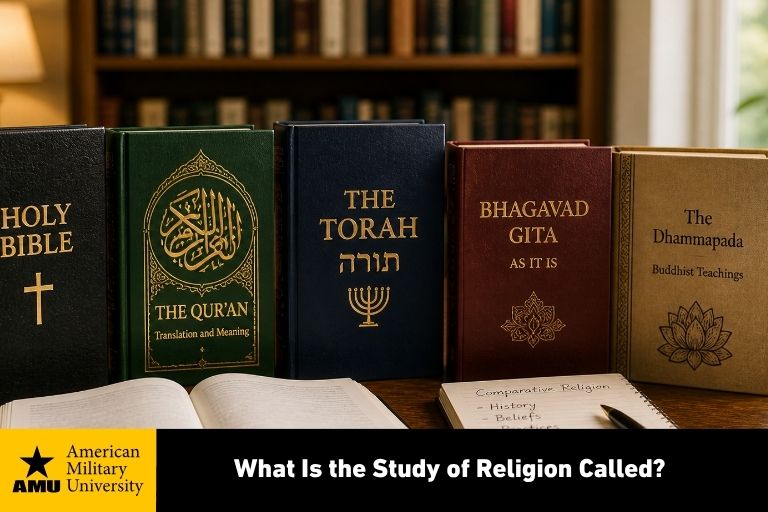
Understanding the Different Ways Religion Is Studied
Religion influences how many people understand identity, morality, community, and the world around them. It shapes cultures, informs traditions, and continues to play a role in public life, literature, history, and social institutions. Because of that, many students eventually ask the same question: What is the study of religion called?
In most academic settings, the broad study of religion is usually called religious studies. This field looks at religion through an academic lens rather than a devotional one. It asks how religious beliefs, rituals, institutions, and religious traditions develop, how they shape societies, and how they connect to the wider human experience.
At the same time, students may also come across terms such as theology, theological studies, and comparative religion. These areas are related, but they are not exactly the same.
Some focus on the broader academic study of multiple traditions, while others focus more closely on one faith tradition and its internal teachings. Understanding those differences can make it easier to choose the right degree program.
Religious Studies: The Academic Study of Religion
For most students, the most direct answer to what is the study of religion called is religious studies.
Religious studies is the systematic study of religion as a human and cultural phenomenon. Instead of promoting one set of beliefs, it examines how religion functions in history, society, politics, ethics, and everyday life. That is why the field may draw from several academic disciplines, including:
- History
- Anthropology
- Sociology
- Political science
- Philosophy
- Cultural studies
This interdisciplinary approach helps students develop a deeper understanding of how religion shapes communities and institutions. It also encourages critical thinking, because students are asked to analyze ideas, compare traditions, and interpret practices in context.
A religious studies course might explore world religions, sacred stories, ritual practices, religion in America, or the relationship between religion and human rights. In that sense, religious studies takes religion seriously as a subject of inquiry, while still maintaining an academic perspective.
Theology vs Religious Studies: Key Differences Explained
Although they overlap, religious studies and theology usually approach religion in different ways.
Religious studies may look at religion from the outside. It compares traditions, studies their development over time, and examines how religion affects culture, law, and human behavior.
Theology, by contrast, is often more concerned with the internal beliefs and teachings of a particular tradition. It asks questions about doctrine, interpretation, and the nature of God, faith, and moral life.
The word theology itself comes from ancient Greek, combining theos and logos, and is commonly understood as the study of God or divine things.
A simple way to think about it is this:
- Religious studies usually studies religion comparatively and academically
- Theology usually studies belief from within a specific faith tradition
That distinction matters for students comparing a religion degree with a theology degree. One is often broader and more comparative. The other may be more tradition-centered and interpretive.
What Is Comparative Religion in the Study of Religion?
Another term students may encounter is comparative religion, which refers to studying multiple religious traditions side by side. Rather than focusing on a single belief system, this approach explores how different religions relate to one another—examining both their similarities and their differences.
In practice, this may involve looking at themes such as creation stories, ritual and worship practices, and perspectives on suffering or salvation. It may also include exploring ethical frameworks, community structures, and how different traditions understand meaning, identity, and the world.
This type of study can help students develop a broader understanding of belief systems beyond their own background. It also encourages more thoughtful consideration of how religion shapes society, culture, and even political systems.
What You May Learn in a Religion Degree Program
A religion degree is often broader than students first expect. It does not only focus on belief. It may also examine symbols, rituals, ethics, literature, history, and public life.
A Bachelor of Arts in Religion introduces students to the cultural, political, and social dimensions of religion. This includes the study of religious traditions, sacred places, ethics, symbols, and rituals while helping students understand religion’s influence across human history and contemporary life.
Coursework in a religious studies program may include topics such as:
- Introduction to the Study of Religion
- Introduction to World Religions
- Religion in America
- Christianity
- Race and Religion
- Religions of the Middle East
- Myth and Ritual
- Sociology of Religion
- New Religious Movements and Cults
Religion Bachelor’s Degree and Master’s Degree Options
Students exploring this field may wonder whether a bachelor’s degree or a master’s degree makes more sense.
A bachelor’s degree in religion or religious studies often introduces students to the foundations of the field. It usually emphasizes broad reading, analysis, writing, and exposure to multiple traditions and approaches.
A master’s degree may allow students to dive deeper into a specialized area, such as theology, ministry, ethics, interfaith studies, or advanced textual interpretation.
A bachelor’s degree may be useful for students who want to:
- build a broad academic foundation
- study religion from multiple perspectives
- strengthen research and writing skills
- explore religion alongside history, philosophy, or political science
A master’s degree may be useful for students who want to:
- focus more deeply on a specialty
- pursue advanced theological or academic work
- continue into more specialized graduate study
Options may be dependent on individual goals and career paths.
Why Students Choose to Study Religion
Students are often drawn to the study of religion for a variety of reasons. Some want a clearer understanding of specific beliefs or traditions, while others are interested in the broader ways religion shapes culture, conflict, law, and identity.
For some, the focus is theological; for others, it’s more about exploring religion through an academic and interdisciplinary lens.
Along the way, students engage with complex questions about meaning and purpose, as well as the role of faith in public life. They may examine how religion has influenced history and culture, how it intersects with human rights, and how different traditions approach morality, suffering, and the nature of existence.
In addition to subject knowledge, studying religion may help students develop valuable skills such as research, writing, critical interpretation, and problem-solving—tools that can be applied across many fields and careers.
Exploring Your Path in Religious Studies and Theology
So, what is the study of religion called? In most academic settings, it is called religious studies. But depending on the student’s goals, it may also involve theology, comparative religion, or another area of structured inquiry.
For those who want a broad, interdisciplinary, and comparative approach, religious studies may be the stronger fit. For those who want to focus more deeply on one faith tradition, sacred texts, and doctrinal questions, a theology degree may be more appropriate.
Explore how a religion degree may connect to diverse career interests and areas of service in "What Can You Do With a Religion Degree?" and consider the possibilities this field of study may offer.