By Dr. Jarrod Sadulski | 08/24/2026
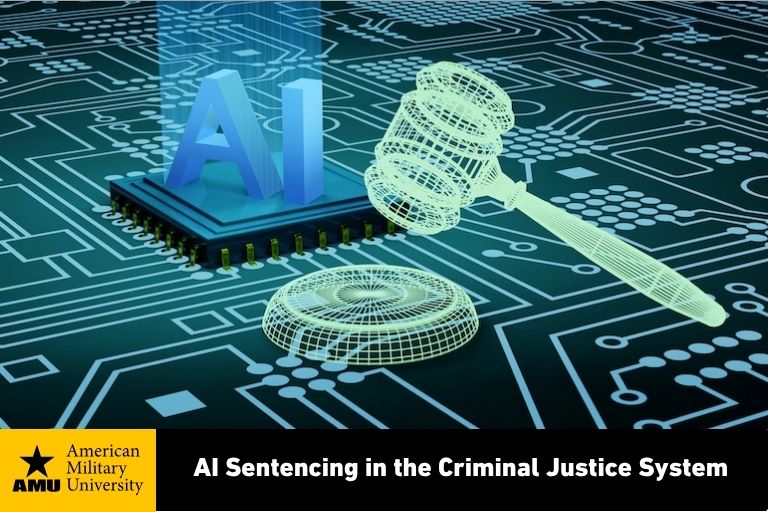
Artificial intelligence (AI) technology has changed many aspects of our lives. AI is all around us and is often used daily without people realizing it because many smartphones, computers, and smart devices rely on it. However, AI also has its uses in the criminal justice system.
Artificial Intelligence and Predictive Policing
AI tools are especially important in the criminal justice system for increasing public safety and protecting human lives. For example, AI tools enhance the capabilities of predictive policing, enabling law enforcement to determine crime patterns.
Predictive policing involves using algorithms and previous crime data to make proactive predictions and determine crime hotspots. AI tools can be a force multiplier, helping law enforcement agencies to identify locations before crimes occur.
Using AI in Criminal Investigations
For criminal investigators, AI tools are especially useful in investigations. For instance, AI tools can be used to compare biometric information to large datasets to identify potential suspects and victims. Similarly, AI tools can help investigators to locate missing persons and stolen vehicles using public cameras and license plate scanning technology.
AI can also be effective at improving video analytics. For example, AI tools can enhance investigator capabilities by reviewing large quantities of video footage to identify patterns of criminal activity and suspicious behavior. AI software can detect evidence in surveillance videos that may otherwise be missed by human investigators.
In addition, AI can enhance digital forensic analyses through its pattern recognition capabilities and aid with criminal cases. For instance, AI software can cross-reference large datasets between transnational criminal organizations, review large amounts of financial transactions, and find indicators of money laundering.
AI is especially effective in combating human trafficking. By analyzing posts and messages, AI systems can monitor online communications and detect victim grooming and recruitment. AI can also be utilized to locate potential human trafficking victims.
The Use of AI in Courts and Sentencing
A growing interest exists in leveraging AI software to strengthen the legal system. AI software integration can support the court system by processing tens of thousands of documents very quickly to analyze data.
This software could help the court system prioritize tasks and cases by order of legal requirements and the offender’s risk. Such systems can utilize AI to automate routine tasks in the legal field.
AI software and machine learning can assist with analyzing court filings and records to identify patterns associated with an offender’s risk and key data. AI can help to summarize extensive legal paperwork and can be effective in saving time for employees in the criminal justice system.
Judges and prosecutors may also use AI tools to prepare for court by analyzing and organizing various forms of evidence. In the courtroom, AI software can help witnesses to overcome language barriers and assist court personnel with decision making. AI sentencing could potentially increase the efficiency of a court system, reduce the costly backlog of cases in U.S. courts, and reduce incarceration rates to ease the pressure on crowded court systems.
AI can quickly identify case laws based on previous court cases and inconsistencies between legal precedents. It can also save taxpayer dollars by providing support for judicial decisions that may be less likely to be appealed.
To identify the risks associated with offender recidivism, AI tools could evaluate an offender’s risk score. For instance, AI software could aid sentencing decisions by identifying low-risk offenders and high-risk offenders and analyzing large datasets of information to determine re-offending patterns and future criminal behavior.
AI tools can help ensure whether a proper sentence was issued to an offender. For this purpose, AI integration into a court system could:
- Examine an offender’s criminal history
- Review the sanctions issued for the same crime committed by other offenders
- Analyze victim impact statements and the outcomes of previous cases with relevant characteristics
- Check a criminal’s substance abuse history that may have contributed to a drug crime
- Determine what alternative sanctions or alternative punishments would be appropriate
AI may help reduce some forms of human bias in sentencing decisions, but AI systems can also reflect biases present in the data used to train them. However, AI can also help to ensure an offender receives the appropriate amount of jail time during sentencing.
Despite the many applications of AI, it is important to remember that AI software outputs can contain errors. Human judges and others in the criminal justice system still need to review AI-generated documents for accuracy.
Correctional Offender Management Profiling for Alternative Sanctions
The National Institute of Justice (NIJ) conducts research that reviews the effectiveness of criminal justice tools, including artificial intelligence. The National Institute of Justice also advises law enforcement agencies on best practices when they use AI software for criminal justice needs.
One software tool that the National Institute of Justice has researched is the Correctional Offender Management Profiling for Alternative Sanctions (COMPAS). This AI-based tool is intended to help law enforcement agencies reduce implicit bias or racial bias in the correctional system, which can be especially important for Black defendants and other minority defendants.
COMPAS assists in the decision-making process for judges, parole officers, and many other administrators. It assists with evaluating the most appropriate approach in inmate supervision based on risks, proper treatment, and effective rehabilitation.
COMPAS considers various factors, such as:
- Prior crimes committed by a defendant
- The age when an offender was first arrested
- The results of previous criminal proceedings
- An offender’s employment or lack of employment
- An offender’s education
These factors help COMPAS to determine the likelihood of a criminal reoffending. COMPAS also provides risk scores that assist in the sentencing and corrections process.
Using programs such as COMPAS helps the criminal justice system to avoid cases where judges disproportionately decline consistent sentencing. It can also be used to identify intervention programs and resources that may help criminals to avoid committing future crimes and can reduce prison overcrowding. COMPAS may provide recommendations for probation or other programs that can serve as an alternative to imprisonment.
Ensuring Ethical Standards in AI Sentencing Decisions
It is essential to have human oversight into AI analyses when AI tools are used in the judicial and corrections system. Analysis and reports produced by AI are only as good as the data that AI collects. AI sentencing tools have been typically trained on historical data that demonstrates past inequalities and biases in the criminal justice system.
AI uses machine learning and depends on historical crime data. Consequently, key stakeholders such as judges, prosecutors, and parole officers must have insight into how AI determined the offender's risk and provided recommendations.
Under the Sixth Amendment of the U.S. Constitution, defendants have the right to face their accuser. Since AI pulls a lot of data from different sources and a lack of transparency can exist in terms of AI-generated recommendations, legal questions are likely to arise in terms of how defendants can challenge AI findings.
This situation is especially relevant regarding a defendant’s attorneys challenging evidence analyzed by AI or AI-created recommendations based on machine learning. Unlike traditional human witnesses, defendants and their defense attorneys do not have the opportunity to cross- examine AI-generated evidence.
As AI evolves in the judicial and correctional settings, case laws will need to set precedent regarding:
- Whether AI content can be considered as relevant as traditional testimonial evidence
- Whether defendants or their attorneys should have access to the algorithms used by AI to produce results
- Who is responsible for unjust outcomes, such as the court, the judge or the algorithm's developers
Questions may also arise regarding liability on the part of the AI software development company.
While AI can be used as an effective tool in the judicial system and corrections, human oversight, review, and close scrutiny is essential. Any use of AI can result in errors and AI should be an advisory tool, rather than a final arbiter.
The Importance of Human Oversight in AI Sentencing
Human oversight ensures AI accuracy, especially when important sentencing decisions are based on AI-delivered content and machine learning. Human oversight can aid legal compliance and provide increased transparency on the data used by AI. It can also ensure that ethical decision-making is associated with the use of AI content.
Strategies for accurate AI content include validating AI outputs by comparing it to:
- Case laws
- Victim impact statements
- Other content evaluated by AI
Ultimately, both judges and defense attorneys should understand how AI software reaches its conclusions. Transparency with the use of AI sentencing is essential. For trust to be gained in the court system, defendants and their defense attorneys can examine the AI tools used in AI sentencing and should have the opportunity to challenge AI systems and their output.
With AI sentencing, judges, prosecutors, parole officers, and other stakeholders should receive training on the strengths and weaknesses of AI sentencing tools. They should also know how to properly evaluate the data used for AI sentencing and work to protect data privacy and security.
The Bachelor of Science in Criminal Justice at AMU
For students interested in technology and criminal justice, American Military University (AMU) offers an online Bachelor of Science in Criminal Justice. For this degree program, students can enroll in courses such as criminology, ethics in criminal justice, and criminal investigation. Other courses include constitutional law, criminal law, and crime analysis.
This B.S. in criminal justice also has a digital forensics concentration. This concentration offers courses in wireless networks, computer forensics, cybercrime, and various aspects of digital forensics.
For more details on this bachelor’s degree in criminal justice, visit our criminal justice degree program page.
Note: This degree program is not designed to meet the educational requirements for professional licensure or certification in any country, state, province or other jurisdiction. This program has not been approved by any state professional licensing body and does not lead to any state-issued professional licensure.

Dr. Jarrod Sadulski is an associate professor in the School of Security and Global Studies and has over 20 years in the field of criminal justice. He holds a bachelor’s degree in criminal justice from Thomas Edison State College, a master’s degree in criminal justice from American Military University, and a Ph.D. in criminal justice from Northcentral University.
His expertise includes training on countering human trafficking, maritime security, mitigating organized crime, and narcotics trafficking trends in Latin America. Jarrod has also testified to both the U.S. Congress and U.S. Senate on human trafficking and child exploitation. He has been recognized by the U.S. Senate as an expert in human trafficking.
Jarrod frequently conducts in-country research and consultant work in Central and South America on human trafficking and current trends in narcotics trafficking. He serves as an expert witness in criminology. Jarrod has provided academic presentations across the United States and in Europe, Southeast Asia, and in Latin America on various criminal justice related topics. Also, he has a background in business development.