By Kathy Hieatt | 10/23/2026
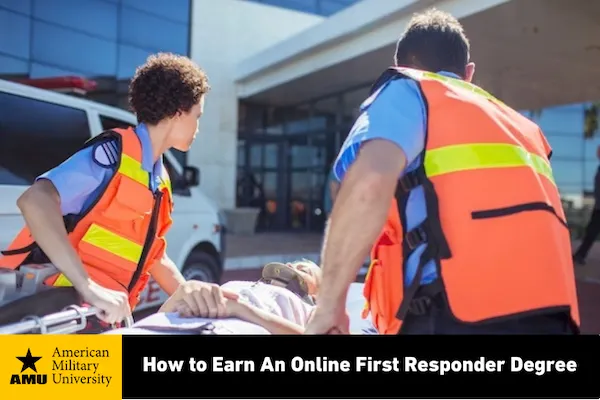
First responders learn on the job – whether you’re fighting fires, solving crimes, or providing emergency medical care to people in need. But as the public safety field advances and becomes more complex, higher education is becoming increasingly important to individuals who want to be part of that first response.
Earning a degree online provides the flexibility that many first responders need to further their education while continuing to serve their community and support their family. If you’re looking to advance your knowledge, here’s everything you need to know.
Do Police Officers, Emergency Medical Technicians, and Other First Responders Need A College Degree?
Most public safety organizations – police departments, fire departments, and emergency medical services (EMS) departments – require a high school diploma or general educational development (GED) certificate for candidates to be hired for entry-level positions. However, many employers require a college degree to be eligible for promotion.
First responder training varies by department. Your department will provide the initial training needed to learn the essential skills for your job, whether that’s fighting fires, providing first aid, responding to hazardous materials incidents, apprehending criminal suspects, or conducting hospital transports for patients. Training is typically a combination of classroom and hands-on instruction.
When you're ready for advancement, a college education can help you prepare for seeking a more advanced position. A college education also provides critical skills for police, firefighters, emergency medical technicians (EMTs), and other emergency responders, such as critical thinking, communication, and problem-solving.
Henry Giammarco Jr., the Chief of Police and Director of Emergency Management in Yeadon, Pennsylvania, has learned the value of higher education firsthand during his 31 years in law enforcement.
“Education is just as important as street smarts,” Giammarco said. “Whatever public safety field you’re in, it opens you up to new ideas.”
Many departments also offer incentives for employees with college degrees. For example, Yeadon offers police officers a $200 annual stipend for 30 college credits and up to $1,000 a year for a master’s degree, Giammarco said.
Going Beyond A High School Diploma: Steps to Earn A First Responder Degree Online
If you’re ready to purse an online first responder degree, here is your roadmap to academic success:
- Decide what major is right for you and your career goals.
- Select a college or university that offers your selected major and meets your budget and schedule.
- Apply for admission.
- Enroll in courses.
Step 1: Decide What Major Is Right For and Your Emergency Services Career Path
The first step to earn a first responder degree online is to decide what major is right for you and your career path. It’s important to do your research, including talking to professionals in the field, Giammarco advised.
“Don’t procrastinate,” Giammarco said. “If you’re thinking about it, lock in and find somebody in your department or in your field that has gone through it and see how it benefits them.”
Select a degree program that will help you prepare for where you want to be in the future. If your goal is to become a fire chief, police captain, or director of emergency management, your studies should support those aspirations.
There are numerous higher education programs that cater to emergency medical responders and other first responders. A few include:
- Emergency and disaster management
- Fire science
- Criminal justice
- Public administration
Step 2: Select A College or University
Once you’ve decided on a course of study, find a college or university that offers your selected major. Start with a list of criteria that meet your budget, lifestyle, and academic requirements. Consider:
- Academics – Does the college or university have a rigorous academic program that will help you succeed in your field? How is it ranked compared to other schools?
- Accreditation – Is the college or university accredited? Is the program you plan to study accredited? Accreditation matters because it ensures the school meets quality standards, is eligible for student financial aid and veteran benefits, and awards transferable credits.
- Budget – Does the college or university fit your budget? What is the cost per credit and the total estimated cost to earn your degree? Are there additional costs involved, such as for textbooks? Does the college or university offer grants, scholarships, or tuition discounts for active-duty emergency personnel to improve affordability?
- Course structure – What’s the course schedule? How often do courses start and how long do they run?
- Enrollment – What is the process and criteria for enrollment? Is there rolling admission or a set application deadline? Are enrollment exams required? Are there enrollment fees? Is there a minimum grade point average (GPA) requirement? For example, some graduate degrees require a minimum GPA of 3.0.
- Expertise – Are the faculty experts in your field? Do they have both the necessary academic credentials and real-world experience?
- Location – Do you want to study in-person on a campus, online, or a combination of both? If in-person, what options are available nearby? If online, does the program require in-person internships or hands-on practical training?
- Transfer credits – Does the school or university accept transfer credits for prior college courses, job training, or experience? Is there a transfer credit evaluation and what’s the cost, if any?
In addition to examining the school’s website and course catalog, consider talking to alumni and consulting expert sources – such as the U.S. Department of Education College Scorecard, College Factual, and U.S. News and World Report®. These websites rank schools on cost, acceptance and graduation rates, academic quality, and more.
An online degree program is a great choice for first responders looking to go beyond their emergency training, said longtime first responder Dr. Terri Wilkin, the Emergency Management Department Chair at American Military University (AMU) part of American Public University System. Whether you're just completing your department's training program or preparing for advancement, studying online provides the most flexibility.
"The major benefit is they work shift work; their hours are long," said Wilkin, who served as a state trooper, investigator, and prosecutor in Maryland for 25 years. "You're going to miss classes if you go in person, where online you can do it on your time."
That means completing coursework on your own schedule and when you have breaks from ambulance, fire, and police calls.
Step 3: Apply for Admission
Once you’ve selected the right program and school, follow its enrollment process. Procedures vary, but most require that you:
- Complete an application online
- Submit proof of a high school diploma or General Educational Development (GED) certificate
- Have a valid, government-issued ID
- Provide any prior college transcripts
Some colleges or universities may also require admission essays and test scores, such as from the Scholastic Aptitude Test (SAT®) or American College Testing (ACT®). Admissions may require official transcripts and letters of recommendation.
Step 4: Enroll in Courses
Once accepted into your college or university of choice, your next step is to enroll in courses.
Dr. Wilkin recommends starting with a certificate or nano-certificate (NanoCert®) to determine whether the major you’ve selected is a good fit for you.
For example, AMU offers several certificates and NanoCerts for first responders, which involve completing six online courses and three online courses, respectively. They include:
- Undergraduate NanoCerts
- Basics of Emergency Management
- Community Risk Reduction Chief
- Disaster Management Fundamentals
- Emergency Management Communications
- Undergraduate Certificates
- Emergency Management
- Fire Science
- Law Enforcement Leadership
“My advice would be: don’t start with English 101. If you really want to do the first responder stuff, start with the fire science course or the emergency and disaster management course,” Wilkin said. “General education courses can turn a lot of students away, so I think it’s a good start for them to hop into the topic that they’re interested in as opposed to doing all the gen ed first, especially with the older adult learners.”
If you choose to continue your higher education, the credits you earn as part of a certificate or NanoCert can count toward your degree.
The Online Bachelor of Arts in Emergency and Disaster Management at AMU
The Online Bachelor of Arts (BA) in Emergency and Disaster Management is a natural fit for first responders looking to advance their knowledge. The program is taught by expert instructors who are board-certified emergency managers (CEM). Its primary focus is the prevention, mitigation, and recovery of man-made and natural disasters. Coursework explores:
- Emergency and disaster management phases
- Crisis management
- Emergency preparedness
- Counterterrorism
- Risk assessment
- Hazard identification
This program provides a unique opportunity to connect with other first responders in your field, Dr. Wilkin said.
"They can apply what they're learning while they're doing their job," she said. "So they can take their skills with them, and they can bring their real-life experience into the classroom."
A bachelor’s degree in emergency and disaster management at AMU requires 120 credits and allows you to transfer up to 90 credits. Courses are entirely online and start monthly, lasting 8-16 weeks. AMU makes higher education accessible and affordable by offering:
- No entrance exams
- $0 application fee
- $0 transfer credit evaluation
- $0 ebooks
Tuition Grants and College Credit for First Responder Training and Certifications
First responders – and their family members – are eligible for AMU’s Everyday Heroes Grant, a 20% tuition grant. Police officers, firefighters, paramedics, and other first responders may also receive college credit for their responder training and responder certifications, including EMT training, basic academies, and:
- Basic Law Enforcement Training (BLET)
- International Fire Service Accreditation Congress® (IFSAC®) certifications
- Federal Law Enforcement Training Accreditation (FLETA)
- National Registry of Emergency Medical Technicians® (NREMT®) certifications
- Police Officer Standards and Training (POST)
The program is accredited by the International Fire Service Accreditation Congress (IFSAC), which ensures the quality, integrity, and consistency of programs for firefighters and emergency service providers worldwide. This specialty accreditation adds a level of rigor to the curriculum and demonstrates to employers that graduates have achieved the required knowledge and skills to perform in their professions.
Start your journey today by learning more about the BA in Emergency Management at AMU at AMU.APUS.edu.
*Note: This program is not designed to meet the educational requirements for professional licensure or certification in any state. These programs have not been approved by any state professional licensing body and do not lead to any state-issued professional license.
College Factual® is a registered trademark of Bright Hub, Inc.
U.S. News & World Report® is a registered trademark of U.S. News & World Report, L.P.
SAT® is a registered trademark of College Board.
ACT® is a registered trademark of ACT Education Corporation.
NanoCert® is a registered trademark of American Public University System, Inc.
International Fire Service Accreditation Congress® and IFSAC® are registered trademarks of Board of Regents for Oklahoma Agricultural and Mechanical Colleges.
National Registry of Emergency Medical Technicians® and NREMT® are registered trademarks of National Registry of Emergency Medical Technicians.
Kathy has over 18 years of experience in journalism and public affairs. She writes print and digital content for first responder and military audiences in the B2B, B2G, and B2C sectors.