By Dr. Scott Van Hoy | 07/27/2026
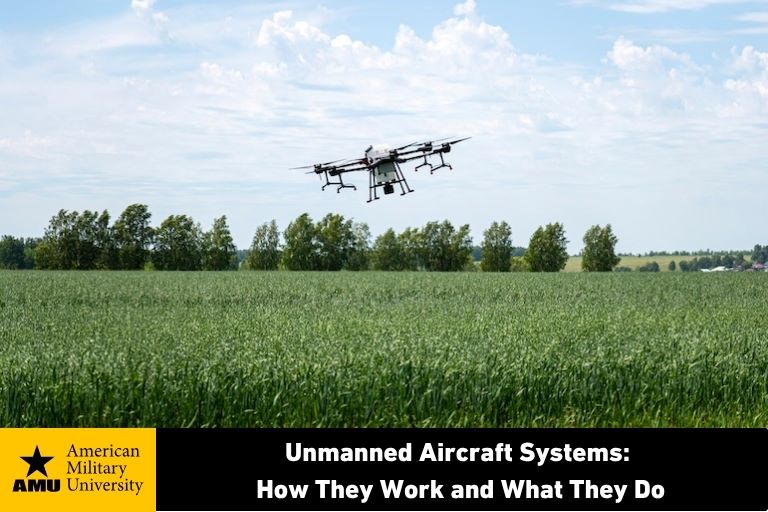
Unmanned aircraft systems (UAS) involve aerial vehicles and their associated network of systems. The characteristics of unmanned aircraft systems include:
- No humans are on board.
- They are controlled or monitored from a remote pilot station via a command-and-control link.
- They use either a rotary-wing or fixed-wing design.
While “unmanned aircraft systems” is the standard term in some industries, other terms can be used to describe similar technology, such as:
- Drones or combat drones
- Unmanned aerial systems
- Uncrewed aircraft systems
- Unmanned aerial vehicles (UAVs)
- Remotely piloted aircraft systems (RPAS)
- Military UAVs
- Tactical UAVs
Some military organizations operating larger aircraft prefer to use RPAS. Drones are often used to refer to small UAS (sUAS), typically in the form of quadcopters.
The Components of Unmanned Aircraft Systems
Unmanned aircraft systems consist of many of the same components as other aircraft. For instance, they have:
- A propulsion system
- A flight control system
- A navigation system
- A payload system
What makes UAS unique compared to manned aircraft is the need for a communications system. This communication system relays flight information directly to a pilot operating a drone from a remote location.
Also, a drone’s autonomous systems are frequently more robust than manned aircraft. For instance, if the command-and-control link between the remote pilot and the drone is degraded or lost, the drone can safely recover on its own. Some drones even use artificial intelligence (AI) to aid with the automation.
The payload system depends on the job the drone is designed to complete. For instance, the payload of a real estate photography drone is significantly different from a military strike drone.
Some common payload technologies include:
- Electro-optical and/or infrared cameras
- Multispectral sensors
- Light detection and ranging (LiDAR) systems
- Cargo delivery mechanisms
Larger unmanned aircraft systems can be outfitted to carry radar systems, electronic intelligence sensors, electronic warfare sensors, and military weapons. These payload technologies are useful in giving military forces a strategic advantage over enemy forces.
Where Are Unmanned Aircraft Systems Used?
The UAS industry is expected to continue growing in the coming years as more civil organizations and military services adopt this technology. Some of the most popular applications for drones include:
- Military reconnaissance, surveillance, and defense
- Photography and videography
- Logistics and delivery
- Emergency response
- Infrastructure inspection
- Mapping and surveying
- Agriculture and farming
- Environmental research and monitoring
- Space exploration
- Other civil applications
Military Reconnaissance, Surveillance, and Defense
Military UAS excel at completing government and defense missions that are considered too dull, dirty, or dangerous for a manned aircraft. For example, a mission that requires long waiting times, involves environmental hazards such as radiation, or is in an area that has active enemy air defenses is a good candidate for a UAS mission.
Once a military drone is in use, it excels at conducting persistent intelligence, surveillance, and reconnaissance (ISR), as well as precision strikes. However, a drone’s payload can vary depending on mission needs.
Due to the increasing popularity of military unmanned aircraft systems, counter-UAS (c-UAS) are continually being improved to mitigate the threats posed by military drones. Small drones are difficult to detect and engage, and they are capable of attacking as a swarm.
Also, their designs are continually evolving as technology improves. Consequently, new anti-drone defense systems must be built at dedicated military bases to counteract the danger.
It is important to remember that industry growth in the defense sector is limited by government defense budgets and export controls that limit where U.S. companies can sell their unmanned aircraft systems.
The International Traffic in Arms Regulations (ITAR) prohibits unmanned aircraft and related technologies classified as defense articles on the U.S. Munitions List from being exported without authorization from the U.S. Department of State.
Photography and Videography
Photography and videography are the most common UAS applications and the images/videos can be used by government agencies, businesses, and recreational pilots. Videography is especially popular among recreational drone pilots.
Commercial drone applications often include taking still images or videos for:
- Real estate transactions
- Fine art photography
- Movies
- Television shows
- News reporting
- Sporting events
Photos taken by a drone can also be utilized to create three-dimensional images. By stitching together a mosaic of photos taken from different angles, the photos can be used to create three-dimensional images. This process, called photogrammetry, shows how a basic camera on a UAS can be used for advanced applications.
Logistics and Delivery
Delivery UAS, which serve as delivery drones, have transformed how logistics companies handle last-mile delivery. There is some fun and practicality in having a package delivered to your yard via a drone, especially in rural areas where a trip to the store may take hours.
More importantly, this capability to deliver products by air can save lives by delivering food and medical supplies quickly to remote areas or in time-critical situations. Using UAS to fly medicine to a remote clinic without the required supplies to treat an ill patient or supplying an automatic external defibrillator to a recreational boat with a heart attack patient onboard could be the difference between life and death.
Emergency Response
During an emergency, first responders must maintain situational awareness for their own safety. Unmanned aircraft systems can quickly provide visual information to aid:
- Law enforcement officers
- Firefighters
- Search and rescue personnel
- Security patrols
- Disaster response teams
For instance, first responders using a UAS with a video camera can obtain real-time information about an emergency scene and communicate that information to others in their organization.
Unmanned aircraft systems can also help planners prepare for emergencies. For example, using UAS at large events or in public spaces can enable planners to gather aerial data and develop pre-planned responses in the event an emergency occurs.
In addition, unmanned aircraft systems can aid scene reconstruction and damage assessment. It can assist investigators with forensic analysis and teach lessons to manage future risk.
Infrastructure Inspection
Certain infrastructures can be expensive and dangerous to inspect in person, such as
- Bridges
- Pipelines
- Roads
- Railroads
- Tunnels
- Communication towers
- Power lines
- Plants
Unmanned aircraft systems can reduce the danger for humans because their cameras can be used to conduct visual inspections. Also, sensors can be added to a drone to detect infrared emissions or unwanted chemical emissions.
Mapping and Surveying
UAS can be used to create maps and surveys through cameras and LiDAR technology. The maps are often required for analysis, planning, and visualization purposes, while surveys are sometimes used for legal and engineering purposes.
Agriculture and Farming
Farmers often have thousands of acres to monitor and tend. To improve the yield per acre, technological advancements have enabled farmers to monitor and apply precise corrections to the crops that need them. Using drones to monitor crops and determine where agricultural chemicals and water are most needed helps prevent farmers from overusing their resources or losing crops due to unseen issues.
Crop health is often monitored using unmanned aircraft systems equipped with a near-infrared sensor, and near-infrared light is reflected strongly by photosynthesizing plants. Fields with less near-infrared reflections indicate a possible nutrient deficiency, plant health concerns, or water deficiency.
If a farmer detects issues with part of a crop, a drone can be outfitted with a sprayer and agricultural products. The payload of the drone can then fix the problem.
Environmental Research and Monitoring
UAS applications for environmental research and monitoring are vast. Some drones are being used to conduct air and water quality sampling, monitor animals, and explore new planetary environments. This data collection is crucial for public safety and conservation.
Unmanned aircraft systems can be equipped with air-quality sensors to rapidly detect atmospheric chemicals in three-dimensional space. Air quality differs at the surface compared to higher in the atmosphere, which impacts both public health and agriculture.
Water quality sampling is achieved by adding a water-collection payload to the bottom of the drone, allowing it to fly into remote areas and collect water samples more quickly than a human could. This technology has the potential to enable rapid collection and assessment of water quality across an entire body of water.
Animal conservation efforts require tracking and observing animals in their natural habitats. For some animal species, drones can be a non-intrusive, cost-effective method for observing them. This knowledge can be used to reduce any disturbance to sensitive species and ensure that regulations protecting a particular species are properly enforced.
Space Exploration
Environmental research using UAS isn’t limited to Earth. For example, the Ingenuity Mars Helicopter was a small, autonomous drone sent to Mars to complete the first powered flight on Mars.
After successfully completing several test flights, Ingenuity continued to explore Mars and conduct aerial scouting missions. The data collected by Ingenuity will help inform decisions about how future Ingenuity-class helicopters on Mars can conduct science using future payloads.
Other Civil Applications
There are numerous other applications for UAS, and new applications are frequently being developed and engineered.
One such application is light shows. Fireworks displays are being replaced by swarms of drones that light up the night sky, forming elaborate patterns synchronized with music.
Another application is drone racing. Major League Drone Racing hosts frequent events featuring about a dozen major league teams across the U.S.
Operating Unmanned Aircraft Systems
The Federal Aviation Administration® (FAA) regulates unmanned aircraft systems flight operations in the U.S. and drone pilots. These FAA regulations ensure aviation safety against hazards such as a collision or crash involving:
- Other aircraft
- Ground-based towers
- Civil infrastructure
- People
Ensuring aviation safety means that airspace integration and air traffic management for UAS are just as important to a UAS operator as they are to a manned aircraft pilot. When a pilot wants to obtain FAA certification to operate a UAS in the U.S., the pilot must first understand:
- The type of UAS
- The type of operation that will be conducted with the unmanned aircraft system
For example, a commercial operator using a UAS with a takeoff weight of less than 55 pounds must obtain an FAA Part 107 Remote Pilot Certificate.
Unless a pilot has already received FAA certification, the FAA Part 107 Remote Pilot Certificate requires studying for and passing the unmanned aircraft general knowledge test. This test covers the information required to safely operate a UAS within the national airspace system.
Key topics in this certification’s test include:
- Airspace classification
- Operating requirements
- Flight restrictions
- Aviation weather
- Aircraft loading
- Emergency procedures
- Pilot performance
- Aeronautical decision making
- UAS maintenance
In addition to operator certification, drones must be registered. Registering a UAS with the FAA requires submitting limited information about the owner and the drone’s make, model, and serial number. Registrations are valid for three years.
Once the operator is certified and the UAS is registered, the operator must also decide if the required operations will be within Visual Line of Sight (VLOS) or Beyond Visual Line of Sight (BVLOS). Part 107 requires UAS pilots to maintain VLOS with their drones.
If a job requires BVLOS operations, a Part 107 waiver must be submitted to and approved by the FAA. As BVLOS operations become more prevalent and UAS technology improves, the FAA will establish new regulations to better accommodate UAS operations. BVLOS operations will soon be governed by the new FAA Part 108, a new set of rules, permits, and certification requirements.
The Future of Drone Technology
The field of unmanned aircraft systems is a field where continuing education regarding rules, regulations, and aviation safety best practices are required to operating drones safely. In the future, pilots and organizations are likely to find even more creative uses for drones – there are many possibilities!
The Bachelor of Science in Space Studies at AMU
For students interested in studying space-related topics, American Military University (AMU) offers an online Bachelor of Science in Space Studies. This degree offers a variety of courses in topics such as the history of space flight and space weather. Other courses include planetary and space exploration and the coevolution of society, culture, and technology.
This degree program offers six concentrations to enable students to tailor their education to meet their personal goals. Students who wish to become drone pilots may be especially interested in the Unmanned Aircraft Systems concentration, designed to improve learners’ knowledge of drones and prepare them to earn the FAA’s Part 107 Remote Pilot Certificate.
For more information, visit AMU’s science degree program page.
Federal Aviation Administration is a registered trademark of Federal Aviation Administration.
He earned a bachelor’s degree in atmospheric sciences and a master’s in technology management from the University of Illinois at Urbana-Champaign. Other degrees include a master’s in space studies with a concentration in aerospace science from American Military University and a Ph.D. in human factors from Capitol Technology University.
Scott is a faculty advisor for the American Public University System Analog Research Group (AARG). He aids students in managing, operating, and conducting research for missions at research facilities analogous to spaceflight.