By Leslie Doyle | 01/26/2026
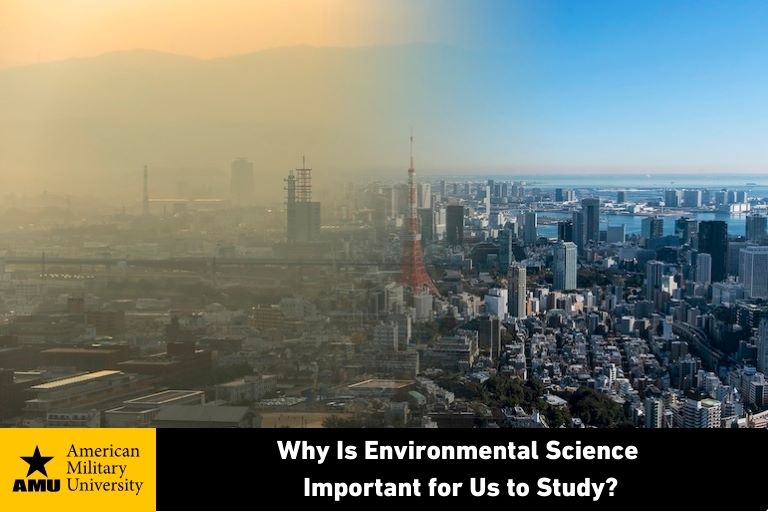
If you’re new to the subject, you may be asking, “Why is environmental science important to study?” However, our future well-being depends on taking a hard look at how we treat the natural resources that sustain us.
There are myriad sources of pollution around the globe that require immediate attention. From combatting coal-fired power plant emissions to tainted water supplies, environmental science professionals have their work cut out for them. Environmental science focuses on these monumental challenges that require the development of practical solutions.
Climate Change
Our natural world faces mounting hazards. Tackling climate change is one of mankind’s most pressing issues. Carbon emissions from fossil fuel plants are causing grave danger. This air pollution has resulted in rising sea levels, melting glaciers, and extreme weather.
While those problems may feel far away, they have a direct impact on humans and animals. For instance:
- Rising sea levels result in increased flooding and threaten everything from sewage treatment plants to public transit and drinking water.
- Melting glaciers increase the nutrients in lakes, rivers, and oceans, disrupting the water supply and fragile ecosystems that plants, animals, and people rely on. This change in our water supply results in biodiversity loss and drinking water contamination.
- Extreme weather results in more pollutants in the air and decreases in air quality.
Communities around the world have already fallen victim to unprecedented heatwaves and uncontrolled wildfires. Environmental education is crucial for developing the future generation’s leaders to solve these environmental challenges.
The Role of Environmental Science
Environmental science is the study of the natural world and the issues that impact it. Environmental science majors apply their knowledge of biology, chemistry, geology, and related sciences to understand what activities impact our air, land, and water, such as:
- Development projects
- Energy usage
- Population growth
Having foundational knowledge in environmental science informs many disciplines, including:
- Wildlife management
- Environmental policy and analysis
- Pollution management
- Public health
Often, students in environmental science programs discover how to assess risks to infrastructure and natural resources. This background can support them in influencing ecological, economic, and social change. Students in this field may go on impact decisions around:
- Land use and city planning
- Environmental legislation
- Renewable energy
- Wildlife management
- The climate crisis
A Short History of Environmental Conservation
Historically, mankind has exploited natural resources to our own benefit and to our peril. As former President Theodore Roosevelt once said, “We are prone to speak of the resources of this country as inexhaustible; this is not so.”
In his speech “Conservation as a Natural Duty,” he stated, “We are coming to recognize as never before the right of the Nation to guard its own future in the essential matter of natural resources…The time has come for a change.”
The Creation of National Parks
President Roosevelt protected roughly 230 million acres of public lands, much of it as national forests. By establishing the U.S. Forest Service (USFS), he created a government agency responsible for overseeing the protection of watersheds and national forests. Through environmental research, the USFS works with local communities to manage natural resources for recreational use, drinking water, and wildlife habitats.
National Environmental Protections
The mid 19th century brought increasing unease around alarming environmental problems. One river in Cleveland actually burst into flames as a result of chemical contamination. The publishing of the book Silent Spring in 1962 was a clarion call for change, exposing how the chemical DDT causes cancer.
Two of the landmark pieces of U.S. legislation responsible for protecting humans today are the Clean Air Act and Clean Water Act. Passed by then-President Nixon, the Clean Water Act established conditions to reduce pollution into U.S. waters. This law built upon the Federal Water Pollution Control Act of 1948. The Clean Water Act was first established in 1972 and has undergone numerous changes since that time to account for additional toxic pollutants.
The Act designated the Environmental Protection Agency with establishing standards for water quality and wastewater disposal.
Also passed in the 1970s, the Clean Air Act is a federal law that authorized the EPA to set air quality standards to protect public health. These standards regulate emissions of known hazards to the air. Over the years, legislators have grappled with how to balance industrial growth with environmental protections, resulting in several amendments to the law.
Environmental Cleanup Efforts
In 1980, then-President Jimmy Carter signed into law the Comprehensive Environmental Response, Compensation & Liability Act (also known as the Superfund Act). This law placed a tax on chemical and petroleum companies to fund cleanup of abandoned or uncontrolled hazardous waste sites.
The Role of Environmental Scientists
The multidisciplinary nature of environmental problems results in intellectually stimulating work for environmental scientists. Environmental science research spans field work and lab work across a multitude of areas. These professionals may be responsible for:
- Collecting air, water, and soil samples
- Making observations of wildlife, plants, and related ecosystems
- Performing data analysis
- Studying the connection between contaminants and human health
- Analyzing social factors that may influence the public’s attitude toward environmental science
- Collaborating with lawmakers and others on building a sustainable future
Real-World Impacts of Studying Environmental Science
The importance of environmental sustainability to our planet cannot be overstated. Pollution destroys ecosystems and degrades water and air supplies. Whether your work involves restoring ecosystems, supporting eco-friendly infrastructure, or lobbying for environmental protections, your efforts can make a profound difference for humans today and for future generations.
Protecting Our Health
Environmental science is crucial for positively impacting human health. One effort involved the disposal of chemical waste from a dye manufacturing company in a quiet Boston suburb.
The Massachusetts Department of Public Health Center for Environmental Health was among the first government agencies to prove a connection between pollution and public health. Although scientists have long believed that toxins in our air, water, and soil lead to disease, the department’s Ashland Nyanza Health Study of 2006 was one of the first research initiatives to make this direct connection.
More than half of the 1,387 study participants had cancer. The researchers found that the risk of cancer was two to three times greater among individuals exposed to the Nyanza plant during their formative years.
The Nyanza site became one of the first Superfund sites. However, removing contaminants from the soil as well as the nearby Sudbury River may take decades.
Elevating Public Awareness of Environmental Problems
Outreach to communities can be advantageous for providing environmental science education about key challenges. Raising awareness in the community can spur individuals to adopt sustainable practices and lobby their legislators to enact environmental safeguards. Awareness campaigns may focus on topics such as:
- The connection between environmental science, conservation, and climate change
- The way that our own actions can improve public health on our planet
- The importance of the role we can play in protecting future generations through environmental sustainability practices
Environmental literacy is necessary to help people understand how our actions affect people and animals. With this knowledge, government agencies can enact meaningful measures, individuals can take personal responsibility, and communities can work together to build sustainable solutions.
On a hopeful front, there have been several successful public awareness campaigns over the years:
- Protecting the earth’s stratosphere – In the 1980s, environmental scientists came together to warn the public about the dangers arising from a hole in the ozone layer. These efforts resulted in a treaty to ban most ozone-depleting chemicals.
- Tackling global warming – More than 400 scientists around the world came to a consensus about global warming and brought international attention to the urgent need to address this problem. Their work led to passage of the Kyoto Protocol in 1997. This international accord compelled 37 countries and the European community to reduce greenhouse gas emissions.
- Raising awareness about microplastics – The World Wildlife Fund launched the “Your Plastic Diet” campaign to educate the public about how microplastics are infiltrating our food supply. The effort called on governments and businesses to reduce plastic waste. Immense public pressure resulting from the campaign led to 40 governments agreeing to participate in a global treaty to lower the use of plastic and dispose of it more responsibly.
Potential Career Paths in Environmental Science
Some environmental science students seek out internship opportunities to gain hands-on experience prior to embarking on a career. Internships may include roles such as:
- Performing data analysis of water samples
- Observing the impact of pollution on nearby communities
- Conducting field work about the natural world
Working as an environmental scientist, however, is just one of the job opportunities available to students with a passion for tackling environmental issues. Environmental science majors may pursue a variety of career paths, depending on individual experience, qualifications, and job market conditions, including:
- Environmental protection jobs in the federal government (such as the Environmental Protection Agency and the National Oceanic and Atmospheric Administration)
- Environmental policy work through federal/state government as well as local planning boards
- Environmental health roles in agencies like the U.S. Public Health Service as well as local boards of health
- Environmental consulting on development/urban planning and related projects
- Environmental justice initiatives through organizations such as the Sierra Club and the Environmental Law Foundation
- Game warden roles safeguarding public places and wildlife
There may also be career opportunities to educate the public through entities such as:
- Nature centers
- Museums
- National parks
However, career outcomes may vary and are not guaranteed.
Studying Environmental Science
If you’re looking to make a real difference in how we eat, breathe, drink, and live, an environmental science degree may be for you. Qualified professionals in this interdisciplinary field usually start with earning a bachelor's degree to gain foundational knowledge.
This major teaches students across a diverse set of areas, such as biology, chemistry, water and soil science, atmospheric science, and environmental ethics. Most students in an environmental science degree program also have classes exploring the connection between the economy and the environment.
After earning an undergraduate degree in environmental science, students may choose to build on this knowledge with a master’s degree. This type of academic program teaches students to apply environmental management strategies to reducing environmental threats.
The Bachelor of Science in Environmental Science at AMU
For adult learners who want to study environmental science, American Military University (AMU) provides an online Bachelor of Science in Environmental Science. This degree program features courses in a variety of topics, including general biology (with lab), atmospheric science, water science, and soil science. Other courses include general chemistry (with lab), environmental economics, general ecology, and environmental and ecosystems management.
This degree also has three concentrations so that students may choose the courses best suited to their professional goals:
- General
- Fish and Wildlife Management
- Climate Change and Resilience
For more details about this B.A. in environmental science, visit AMU’s science degree program page.
AMU staff writer Leslie Doyle is a veteran writer and editor with 15+ years of experience covering high-tech, biotech, higher education, and related business segments. Her previous clients include Cleveland Clinic, Massachusetts General Hospital, Blue Cross Blue Shield of Massachusetts, Adobe Systems, The MathWorks, Novell, Verizon Business, Sony Corporation, MIT, Wellesley College, Tyco Fire & Security, and Avid Technology, as well as many startup companies. Her work has been covered in CIO Magazine, Forbes Magazine, Computer Technology Review, Bioinform, Scientific Computing and Instrumentation, and related publications. Leslie holds a bachelor’s degree in English from Framingham State College.