By Dr. Brittany Jacobs | 12/10/2025
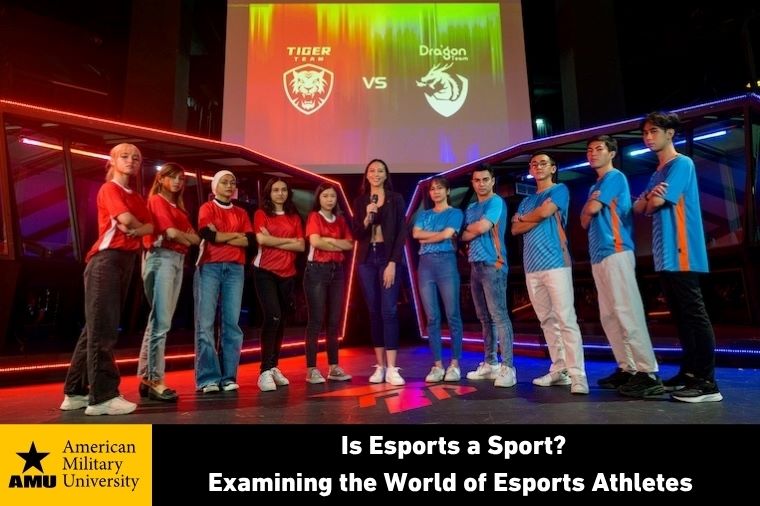
Many people have asked the question, “Should esports – or competitive video gaming – be considered sports?” To answer this question, it is first necessary to consider what makes a sport a sport.
The Oxford Dictionary defines sport as “an activity involving physical exertion and skill, especially one regulated by set rules or customs in which an individual or team competes against another or others.”
As a result, esports fit the definition of a sport. Playing video games in competitions involves:
- Physical exertion
- Competitions involving individuals and teams
- Recognizable skills
- Training
- Leagues
- Governing bodies
Physical Exertion and Competitive Gaming
For some people, esports are not a sport because there is a limited amount of physical exertion. In fact, the general perception is that playing video games leads to sedentary behavior and isn't an athletic competition.
However, esports competitions certainly require physical exertion if you use a broader definition of physical exertion. Esports players need to have:
- Physical stamina
- Neuromuscular coordination
- Quick reflexes
- Manual dexterity
According to Deutsche Welle (German World), academic research conducted by Professor Ingo Frobröse at the German Sports University found that professional gamers “achieve up to 400 movements on the keyboard and the mouse per minute, four times as much as the average person.” Frobröse also noted that this level of strain had never been observed in any other sport.
The physical demands for athletes vary in different sporting roles. However, a study published by three Irish researchers found that professional esports players playing a first-person shooter (FPS) game demonstrated high physical demand with hand acceleration magnitudes averaging 0.96 m/s². These results differ from people playing other types of esports and confirm the specificity of exertion types particularly related to hand motion, reaction time, and upper limb coordination.
Also, high levels of cardiorespiratory fitness have been shown to correlate with faster reaction times in competitive gaming, according to a Human Kinetics Journal article. This physiological advantage allows esports players to process stimuli more quickly and respond with greater precision.
In addition to reaction speed, improved cardiorespiratory health contributes to enhanced in-game accuracy. Esports athletes with better endurance and oxygen efficiency tend to maintain better focus and motor control over extended periods, reducing their errors and improving their overall performance.
These studies suggest that physical fitness, particularly cardiovascular conditioning, plays a meaningful role in cognitive and motor functions relevant to esports. As a result, physical exertion and physical fitness are requirements for online gaming success.
Recognized Sport Skills
While physical exertion and physical activity seem to be a sticking point for the skeptics who do not consider esports a sport, the skill of esports athletes rarely comes into question. Most people generally agree that esports athletes have unique skills and are well-versed at playing their individual games, especially in video game tournaments.
Training for Athletic Competition in Esports
Like traditional sports athletes, esports players are recruited based upon their abilities. Early in the development of video game competitions, professional teams are primarily focused on players’ in-game skills.
Professional esports athletes train roughly 50 hours a week. Depending upon the level of competition, it is normal for esports players to train between four to 10 hours a day. This training includes:
- Positional practice
- Team practice
- Practice in various game scenarios
- Physical training to counteract any health concerns
- Mental health training
Training sessions are led by coaches, who use video to assess opponents and improve players’ strategy.
Today, sport psychology and sport sociology are also considered a part of esports training. Now esports players also focus on physical activity, team dynamics, and mental skills to improve their performance. This type of training regime reflects the same training methods utilized for traditional sports.
Esports Leagues Are Similar to Traditional Sports
Like "real" sports, esports have a long history. Esports competitions with different games exist at all levels, and they have formal, standardized rules and structures. These competitions have existed since the 1970s, and more formal leagues emerged in the United States in the late 1990s.
The Electronic Sports League (ESL) is a league founded in 2000. The ESL has competitions worldwide for professional esports players.
Esports Governing Bodies
In esports, there are governing bodies at various levels. For instance, the High School Esports League, now known as PlayVS, has over 100,000 high school players competing in the United States and Canada. Similarly, the Interstate Scholastic Esports Alliance (ISEA) has over 80,000 athletes competing in esports.
At the collegiate level of esports play, there are numerous governing bodies that organize and formalize competition. Unfortunately, there is not a single governing organization that serves as the major voice of esports.
The National Association of Collegiate Esports (NACE) is one of the governing associations for esports, with 200 U.S. and Canadian schools. NACE performs various functions by:
- Organizing competitions
- Certifying eligibility
- Supporting esports programs
- Helping to ensure a clear path to graduation for competitors
While NACE is one of the largest governing bodies for varsity collegiate esports governance in the United States, there are others. The Eastern Collegiate Athletic Conference (ECAC) serves as both a traditional sports conference and an esports governing body. It launched its esports program in 2017 and ECAC Esports now boasts 315 member schools and over 5,000 teams.
Esports Competitors and Professional Players
Skilled esports players often have the goal of becoming a professional player. However, the percentage of esports players that “go pro” is less than 1%, according to Healthy Gamer. This statistic is similar to the percentage of athletes currently competing in youth soccer academies who will make it to the professional level.
In fact, there are only about 3,530 active esports professionals in the U.S., according to DemandSage. However, reaching such heights requires immense skill from the athlete.
Video Game Publishers: The Link to Professional Esports
Much like traditional sports, each video game publisher has various esports game titles. Each game title – such as Counter-Strike® or Rocket League® – can be considered similar to a sport. Each game title also has esports tournaments and/or world championships, where different teams compete for the ultimate prize.
A unique thing about esports is that these publishers are often the managers of the world championship competitions and events, because they “own” the title of the game and its uses in the video game industry. There have also been some ownership challenges in the esports realm, as each publisher has an inherent monopoly over their game title.
Athletic Scholarships and Prize Money
Video game players, now more aptly termed esports athletes, commonly receive scholarships to play video games competitively at the collegiate level. Esports Insider notes that there are over 60 colleges and universities where an esports athlete can earn a scholarship to compete in their preferred title.
Initially, there was a challenge for universities as professional esports players were used to earning prize money only for competing in esports events. But at the time, traditional sport athletes could not be professionals and earning money for their participation in a sport.
As a result, colleges and universities did not have a precedent for managing and distributing these earnings or dealing with what was essentially a professional esports team at the collegiate level. Without the potential for prize pools, the most skilled players often avoided collegiate play and opted to compete professionally.
Later, the competitive nature of collegiate esports significantly evolved. In many ways, traditional collegiate sports have begun to follow the professional model of esports.
Dedicated Esports Facilities
Most esports teams now have specialized facilities, and many educational institutions now have esports-specific arenas within their athletic complexes.
The University of California – Irvine was one of the first public universities to formalize an esports arena. Since, many major sporting universities have followed suit. For instance, Michigan State University opened the Alienware® MSU Esports Lounge in 2024 to complement its already existing gaming hub.
Esports Management
As esports teams compete in their facilities, matches are broadcast, and analysts and commentators dissect the play. Scouts for collegiate or professional leagues are viewing the games. Also, players’ brands are being built based upon individual performance and personality, and sponsorships are emerging for athletes, teams, leagues, and facilities.
What Value Does Being Labeled as a Sport Provide for Esports?
Esports is now a legitimate sport. However, some people still consider that video gaming involves anti-social behavior that can lead to negative health outcomes, including addiction and obesity.
But since esports are now legitimate, that creates space for additional understanding regarding the mental and physical demands on esports players. That understanding has the potential to drive increased participation and funding.
The Olympic Games and Esports
After originally declining to recognize esports as a competitive sport, the International Olympic Committee (IOC) created a separate event, now known as the Olympic Esports Games.
The first iteration of this event was set to be held in 2027 in Saudi Arabia. But the IOC and Saudia Arabia have mutually agreed to pursue a different path, according to the BBC. It seems that the IOC may now take full ownership of the Olympic Esports Games.
Inclusion in the Olympics will help to increase the public’s awareness of esports and position esports as a legitimate sport sector. However, the Olympics Esports Games’ separation from the Olympics and Paralympics Games suggests that esports are still viewed as “other.”
From an efficiency standpoint, there are benefits to including esports in existing sporting structures. Utilizing existing sports governance models allows esports organizations to avoid having to build their own models from scratch. However, it may also reduce their independence and innovation.
The Future of Esports
The esports industry has proven that it does not need to be considered a sport in all circles to find success. Esports has still found a foothold, first globally and now in the United States. The global esports market is projected to be $3.25 billion in 2025 and is will likely continue to grow in future years.
The biggest tournaments in esports are now drawing similar viewership figures to the Big 5 in American sport. For example, the League of Legends® Championship in 2024 had 6.85 million viewers. By comparison, the NBA post season averaged 6.13 million viewers per game in 2025.
Over the years, esports organizations have come and gone as needs and structures change. Despite these fluctuations, esports is here to stay and will remain a prominent sport in the sports world.
The Bachelor of Science in Esports at AMU
For adult learners interested in gaining more knowledge of modern esports, American Military University (AMU) offers an online Bachelor of Science in Esports. Taught by experienced instructors, courses in this program feature topics such as contemporary issues in esports, the business of esports, and esports events and facility management. Other courses include policy regulations and the esports ecosystem, esports media and production, and an externship in esports.
This degree features two concentrations so that students may choose the concentration that best suits their professional goals:
- Esports coaching and athlete development
- Esports business administration
Also, this degree program has earned specialty accreditation from the Commission on Sport Management Accreditation (COSMA®). This accreditation ensures that the courses in this program have been held to high academic standards by professional examiners.
For more information about this bachelor’s degree, visit AMU’s health sciences degree program page.
Counter-Strike is a registered trademark of the Valve Corporation.
Rocket League is a registered trademark of Psyonix, LLC.
Alienware is a registered trademark of the Dell Corporation.
Counter-Strike Global Offensive is a registered trademark of the Valve Corporation.
League of Legends is a registered trademark of Riot Games, Inc.
COSMA is a registered trademark of the Commission on Sport Management Accreditation.
Dr. Brittany Jacobs is an Associate Professor and Department Chair for the sports management and esports programs at American Military University. She is highly involved in the Olympic and Paralympic movements and worked for USA Rugby before returning to academia. Much of her current research centers around officials and other marginalized populations providing a direct connection to her previous coaching and officiating experiences.
Brittany holds a master’s degree in sports management from the University of Texas, a master’s degree in secondary education from the University of New Hampshire, and a B.S. in kinesiology from the University of New Hampshire, where she also played collegiate field hockey. She earned her Ph.D. in sports & exercise science with a doctoral minor in statistics from the University of Northern Colorado.